

by Serghei Floricel
An innovation is a new or improved way of creating value for customers or users. When starting an innovation project, it is important to understand that there are many ways to innovate, because of differences in how value is created, and in the solutions and activities that enable businesses to create and capture that value. These differences have been the focus of the the Managing Innovation in the New Economy (MINE) research program, led by professors Roger Miller and Serghei Floricel. This program has come to the conclusion that distinct “games of innovation” characterize innovation activities in different sectors of the economy.
Games of innovation are fairly stable configurations of innovation practices, shared by a set of actors (companies, financial institutions, universities, government agencies, etc.) involved in joint value creation activities. These practices revolve around particular ways to create value, and generate specific dynamics of innovation as well as networks of innovators with typical forms. For participants in any innovation project, it is important to understand the logic and the “rules” of their game, in order to participate in it or, on the contrary, to escape its logic.
The logic of each game follows from the dynamic equilibrium that emerges between, on the one hand, the destabilizing forces that prevent companies from creating value through innovation and capturing it in a sustainable way, and, on the other hand, the stabilizing forces that enable the creation of sustainable niches to ensure the survival of businesses and of their innovation activities.
Paradoxically, the main destabilizing factor is the dynamism of the production of knowledge relevant for innovation. This kind of knowledge is constantly produced by fundamental research, R&D and engineering activities, by the accumulation of experience in production, operation and use, and so on. Although this new knowledge generates opportunities for innovation, it also reduces the prospects of creating and capturing value through current operations and ongoing innovation projects.
Three levels of dynamism can be distinguished for knowledge production. The highest level is characterized by a constant production of scientific knowledge that suggests new principles that can be applied to design products. The second level is defined by a constant progression of technological knowledge, which allows significant changes in the shape of products and results in a significant increase of their performance. Finally, the third level is defined by a continuous accumulation of experience with respect to the production, operation and use of existing products and services, which enables the gradual improvement of their performance, quality and reliability as well as the reduction of their cost.
To enable businesses to survive and continue to innovate, the constant pressure stemming from new knowledge and the potential for innovation it creates must be balanced by conditions that give companies the breathing space they need to successfully complete their innovative initiatives and to capture the value they generate. Such protection comes mainly from two stabilizing factors.
A first factor brings together certain conditions that we designate by the term “structuring potential.” These conditions come either from institutional arrangements, such as regulatory or protective measures, or from techno-economic mechanisms, such as economies of scale or network effects. These conditions create a long-lasting advantage in terms of value creation possibilities or costs, or simply keep at bay, at least temporarily, competitors and other potential innovators. We have established three levels for this factor as well.
The highest structuring potential comes from strong regulation. For example, health and safety regulations, such as those in the pharmaceutical or aerospace sectors, prevent the marketing of non-certified products. Similar barriers exist in areas where regulation provides effective protection for intellectual property rights. These conditions prevent, for relatively long periods, any potential competitor or imitator from entering a niche.
The second level comes from mechanisms, such as network effects, which confer a disproportionate and self-reinforcing advantage to some firms. An example of a network effect is the phenomenon when the value of a service increases with the number of its users. This phenomenon explains, well beyond the intrinsic value of the service, the success of Facebook among social media platforms, and of Amazon with respect to e-commerce platforms . This kind of mechanism allows one firm to gain a dominant market share in a lasting way, producing a so-called “winner-take-all” outcome.
Finally, the third level of structuring potential is characterized by scale, scale, learning, differentiation and reputation effects that give companies a smaller but still sustainable advantage over competitors. These effects protect niches by the fact that potential entrants must invest from the beginning important sums in R&D and promotion activities, large-scale assets and operational systems etc. If firms continue to invest in capabilities, these effects can provide them with lasting advantage and protection.
A second stabilizing factor, which we have called “demand specificity”, is related to the fact that the customers targeted by firms in a niche have special requirements, which stem from their advanced and complex needs. Companies that target such customers have the opportunity to accumulate specific knowledge about these needs and the best ways to serve them. The fact that any potential competitor has to repeat this long apprenticeship offers a temporary advantage and protection to current suppliers, because their customers lack viable alternatives. For this factor we have distinguish only two levels. High specificity demand is characterized by customers, often companies, who have unique, advanced and complex needs, while low specificity is related to ordinary and fairly simple needs, often present in commodity and mass markets.
Our main assumption was that niches for innovative companies are viable if the strength of the destabilizing factor, the dynamism of knowledge production, is compensated by equivalent stabilizing factors, in particular by a strong structuring potential and, if this is insufficient, by high demand specificity. Figure 1.1 presents an analysis of these three factors based on the MINE survey, which obtained more than 700 responses from companies in different sectors around the world. The background of this figure presents, in the form of small triangles, diamonds and squares, the averages on the variables that measure the knowledge dynamism and, respectively, the structuring potential for the 38 sub-sectors, distinguished according to the NAICS classification, which had more than five firms in our sample. If the small figures are black or filled with color, the respondents qualified as strong the demand specificity of these sectors. If the figures are white or not filled, the demand specificity is low.
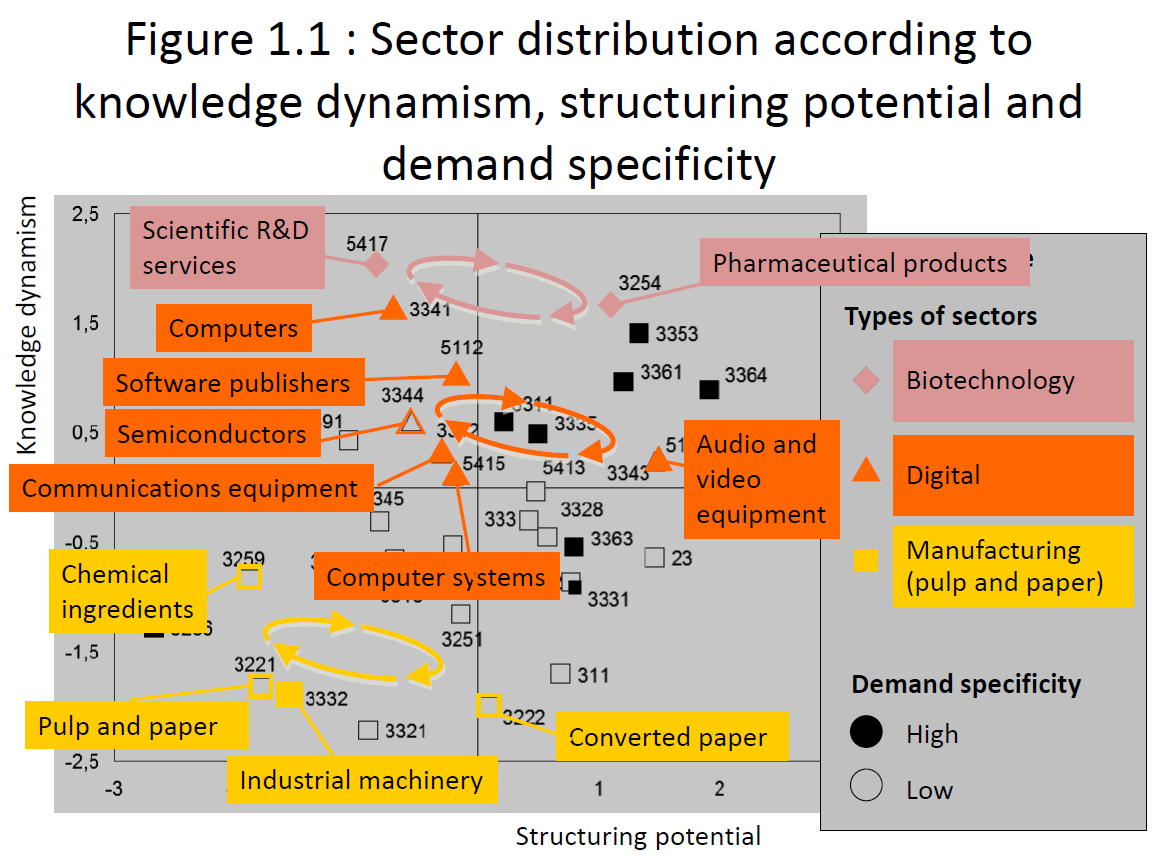
We also classified the sectors a priori in three categories. Sectors represented by small diamonds can be associated with biotechnology, which we assumed to face a strong knowledge dynamism . Small triangles designate the sectors that we call digital, to which we attributed an average dynamism of knowledge production. Finally, small squares designate manufacturing sectors, which we assumed to face, on average, a lower knowledge dynamism .
To exemplify these sectors, we also identified and distinguished by a color code all biotechnology and digital sectors, as well as a subset of manufacturing sectors associated with the production of pulp and paper. A visual examination of the figure shows that the sectors for which we have assumed a stronger dynamism of knowledge are, on average, higher than the others. The figure also validates our hypothesis that sectors subject to a higher dynamism of knowledge (located higher in the figure) also have, on average, a higher potential for structuring (are located further to the right).
The only exception to this relation seems to be in the biotech and digital sectors, but one must keep in mind that much of the innovation activity in biotechnology takes place in the protected environment (more to the right) of universities and government research centers, which are not captured by our figure. The pattern is reproduced even within the three groups. For example, among the manufacturing sectors, the aerospace-related industries, such as the sector 3364, are on average higher and more to right than those associated with pulp and paper production.
In addition, sectors that benefit from higher demand specificity (filled small figures ), are on average higher and more to the left than the sectors that face less specific demand. This means that the former have the possibility to cope with a higher knowledge dynamism with less protection from structuring potential, thanks to their association with clients having unique, advanced and complex needs. All relationships described above have been validated using statistical tests, which support our hypothesis of a dynamic equilibrium between stabilizing and destabilizing forces.
But Figure 1.1 suggests another interesting hypothesis. Different sectors appear to be connected in chains of value creation activities that revolve around a cycle of exchange and renewal of resources for innovation. Exchanges between companies as well as with other actors, such as universities and financial backers, generate opportunities for innovation, redirect resources, including knowledge, towards their achievement and create niches for the companies that pursue them. The niches that revolve around a cycle face similar knowledge dynamics and, thanks to the exchanges between them, synchronize their innovation pace.
This means that certain practices, especially with regard to the knowledge used or produced for innovation and the exchanges with other knowledge-producing actors, are similar in the niches (sectors) articulated around the same cycle. But differences in terms of structuring potential and demand specificity mean that other practices, especially those related to value creation and capture, are specific to each niche. In general, it can be assumed that the sectors in the same area of Figure 1.1 will have similar practices. This assumption allowed us to refine the conceptualization of the game of innovation, as follows.
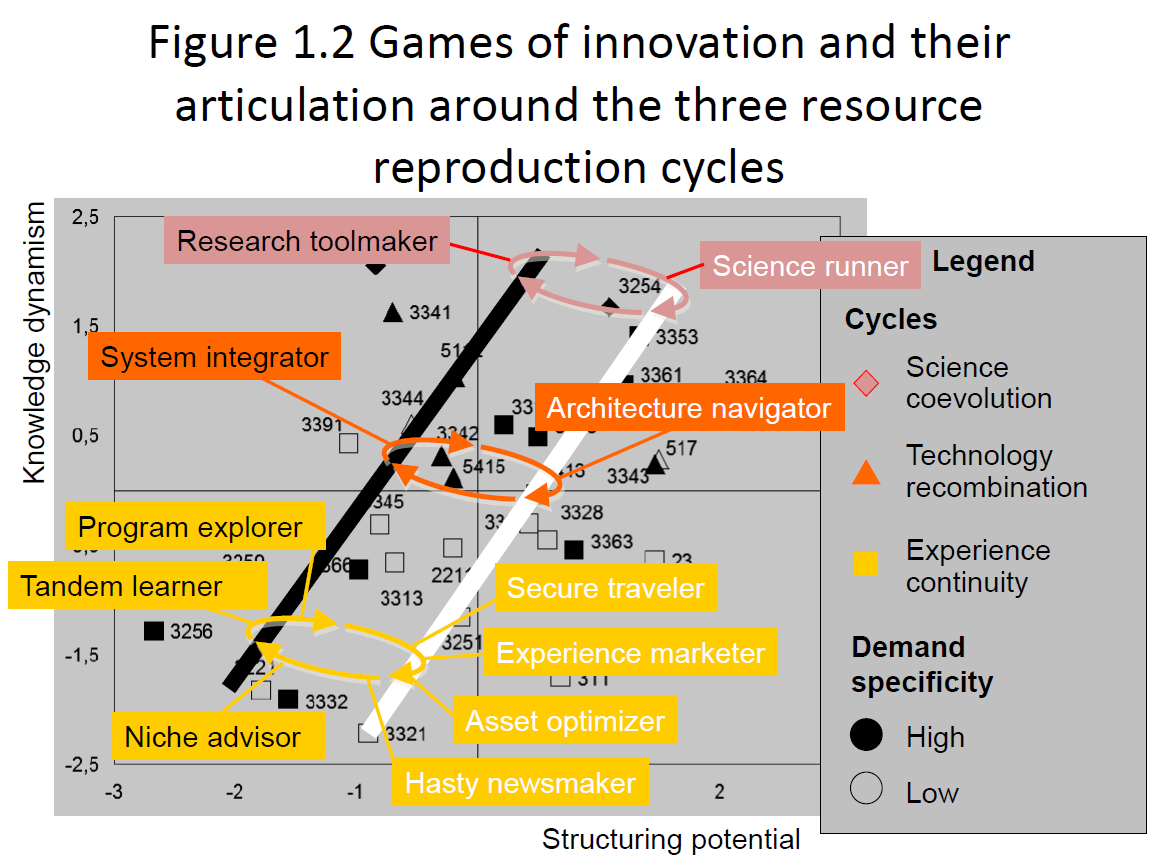
Figure 1.2 also illustrates the three typical cycles of resource renewal for innovation that professors Serghei Floricel and Deborah Dougherty identified. Below, we will explain these cycles, emphasizing the renewal of knowledge, which is a key resource for innovation. We will also exemplify two games for each cycle, one among those with a high demand specificity (names written in black characters) and the other among those with a low specificity (names written in white characters).
The first cycle is called “science coevolution ” because of the very strong interactions between fundamental scientific research, which constantly offers new principles, often radically different, as opportunities for innovation, and technological development, which provides feedback on the concrete difficulties of implementing these principles and on the unexpected phenomena encountered during these activities. This feedback raises new questions for science and helps maintain a very high level of knowledge dynamism. Two games essentially revolve around this cycle.
The first is called “science runner” and represents a structured system of funding R & D activities beyond basic research to transform new opportunities from this research into commercial products. The innovation network is structured like a relay race, which follows the stages of transformation from idea to product. In biopharmaceuticals, a sector dominated by this kind of race, the main stages are called discovery, preclinical trials, clinical trials, and commercialization. A large number of innovative initiatives start at the discovery stage, proposing innovations based on new principles. Many of these initiatives are driven by start-up companies of academic origin because, even if they also generate a large number of ideas, large companies cannot control all knowledge continuously produced. Some players try to go through all the stages, while others specialize in one or two stages, acquiring or selling companies or intellectual property rights. Failure is part of the game and management practices focus on identifying projects with no chance of success and eliminating them as early as possible, to avoid wasting resources. Financing partners, often of the venture capital type, accompany the initiative for a few stages and recover their investment by selling their rights or their shares. A single success can cover the expenses caused by several failures and even generate profits for its backers. This game thrives in a context where innovations are protected by a strong structuring potential, such as a health and safety regulatory framework and intellectual property protection laws that exclude imitators, which compensates for the destabilization caused by the very intense production of knowledge.
The second game of the science coevolution cycle is called “research toolmaker”. This game serves the advanced and complex needs of “science runners” by providing equipment such as visualization, measurement and characterization instruments and software; contract research, data mining and clinical trial services; ingredients, preparations and organisms for experimental research etc. Companies often have their origins among the science runners who are no longer able to attract funding to successfully complete the development of their innovative products, but discover opportunities to take advantage of the skills they developed during innovation activities. This game benefits even more from the opportunities offered by the rapid advancement of science and technology but from a similarly high structuring potential, because neither patents nor health and safety regulations offer sufficient protection. The niches are rather based on a very strong demand specificity, as companies specialize in very narrow applications, highly demanding in terms of accuracy, reliability, etc.
The second cycle of resource renewal for innovation is that of “technology recombination.” In this cycle existing technologies are incorporated into developing technologies, which, in turn, will be incorporated later in new innovations. For the most part, innovation is not the application of radically different principles but a new architectural design that allows the creation of original combinations from existing technologies. For example, smartphones integrate in the same compact artifact cell phones, computers, Internet browsing, cameras and many other applications that were originally developed separately. This cycle also includes, essentially, two games.
The first game of the technology recombination cycle is that of “architecture navigator.” Firms in this game offer uniform products, even if they incorporate highly advanced technologies. Examples include complex digital products aimed at mass markets such as some semiconductors, software (office applications, browsers, video games), Internet platforms (Amazon, Facebook, Netflix etc.) and electronic equipment (smart phones, laptops etc.). The network of companies follows the dominant links that link all these products in an increasingly inclusive architecture to allow their interoperation. This architecture does not only consist in a “horizontal” distribution of functions and interfaces on different modules but also in several “vertical” layers ranging from hardware to software applications. To take advantage of the network effects that mainly generate the barriers that protect this game, companies must promote or align with dominant architectural solutions. As the advancing semiconductor capacities and communication bandwidths, and the incorporation of new applications (Internet of Things etc.) require constant architectural changes, innovation is not just about designing products that encompass more functions, are more efficient or more compact. A good part of the effort consists in finding the best module partition; in favorably standardizing the interfaces that ensure the compatibility between modules; in gaining control, directly or through alliances, of the modules that can ensure customer loyalty and value capture; etc.
The second game of the technology recombination cycle is called “system integrator.” It brings together companies that combine digital technologies into unique systems that meet very advanced and complex needs. Examples include information systems (for companies, banks, governments etc.); communications equipment; and, increasingly, defense systems. Even though these systems include standard components and sometimes revolve around a standardized central core, their realization requires a detailed understanding and even the anticipation of customer needs, the ability to offer customized solutions, the ability to integrate a wide range of technologies into a system that works without a hitch and even to take charge of its operation and maintenance, increasingly offering the result as a service. The protection stems primarily from the dependence that clients develop with respect to such system integrators.
The third and final resource renewal cycle is called “experience continuity.” Innovation in this cycle consists of a steady stream of marginal product and production process improvements that result in increased customer satisfaction; higher product performance, reliability and quality; and reduced costs and undesirable impacts of activities. The know-how that enables these incremental improvements is fueled by learning based on the accumulated experience in designing, producing, distributing and using products. Below, we will discuss in detail only two of the seven games that are associated with this cycle.
The first game is called “asset optimizer”. It brings together companies that produce a large volume of simple goods, often commodities. Examples include large electrical utilities, mining and oil companies, metallurgical and pulp and paper companies, and even large chains of retailers such as Walmart. Over time, these companies accumulate large physical assets. Their innovations focus on improving the productivity of assets, starting with the selection of their size and location, continuing with the development of coordination and logistic approaches, and ending with the identification and elimination of sources of problems and defects. Given the large volume of production, even small improvements that increase asset productivity or reduce downtime, rework and discarded products have a significant overall impact. These companies are protected by economies of scale, by learning and networking effects on assets, by reputation and reputation effects, and so on.
The second game we chose to describe for the experience continuity cycle is “tandem learner.” This game brings together companies that offer systems or services that meet the highly demanding needs of industrial customers, such as companies belonging to the game of asset optimizer. Examples are suppliers of materials, components or advanced infrastructure, for example plants for the production of industrial gases (liquid oxygen etc.). To prevent their products from becoming commodities, companies migrate successively to new areas of application, which have increasingly demanding requirements, identify the most sophisticated customers for these applications and develop a close relationship with them, which allows them to understand their problems and develop solutions. For example, industrial oxygen suppliers have successively served applications related to welding, semiconductor production and biomedical applications. This relationship also temporarily provides suppliers with the protection they need, but only migrating from one application to another allows them to maintain their lead over the producers or similar commodity goods.
This overview has highlighted and explained the differences between innovation activities in different domains. Of course, reality is always more complex than theory. For example, one can ask to what cycle and game belong companies like Amazon? The answer is that through their web platform they play the architecture Navigator game, while through their distribution network they ae close to asset optimizers. So a possible development of this theory is to understand how companies can integrate, in the same organization, practices belonging to different games. But the theory can already allow the managers of innovation projects to ask, very early in the process, questions with a fundamental impact on the success of their project:
- What dimensions of value should our project emphasize? How can we create such value?
- What will be main challenges of our innovation project? What kind of knowledge is important to successfully confront these challenges? How does this knowledge evolve? Where can we get this knowledge? What kind of relationships do we need to develop in order to acquire it?
- What role will we play in the global network of innovation activities? What activities do we need to do ourselves? How should we manage these activities? Who should we choose as partners for the other activities?
- How much time we will have for capturing the value we will produce? How can we protect the value we will create? With whom should we collaborate in order to capture more value?
- How to ensure the sustainability of our company and our innovation activities?
Subsequent themes in this website address in detail most of these questions and give other useful tips to managers of innovation projects. But if you would like to learn more about the current theme, you could read the following papers authored by our team: